

Modern digital products are no longer built on monolithic CMS platforms. Businesses now require API-first content infrastructure, omnichannel delivery, and scalable backend architecture, which is why many organizations are adopting Strapi.
If you are planning a headless architecture in 2026, hiring experienced Strapi developers is one of the most important decisions you’ll make.
According to BuiltWith data, over 10,158 live websites currently run on Strapi globally, with more than 4,000+ in the United States alone, reflecting strong adoption among modern web teams.
Additionally, industry analysis shows Strapi has been one of the fastest-growing open-source headless CMS platforms in 2026, with adoption increasing rapidly across enterprise and mid-market development teams.
However, businesses searching for Strapi development company in the USA often struggle to evaluate developer expertise, pricing, and delivery reliability.
So, here’s a guide that explains:
- Why hiring a Strapi specialist matters
- How to evaluate developers
- Cost differences between hiring models
- Questions to ask before signing a contract
- Why many US companies hire OpenSpace Services (OSS) for Strapi development
Key Takeaways
- Strapi is one of the fastest-growing headless CMS platforms in 2026, powering thousands of production websites.
- Hiring a specialized Strapi developer reduces integration errors and backend performance issues.
- Agencies provide lower operational risk compared with freelancers, especially for enterprise projects.
- US companies often prefer offshore Strapi teams with US timezone overlap, strong NDA policies, and SLA guarantees.
- Transparent pricing and trial sprints help reduce hiring risk.
What Is Strapi and Why Do Companies Hire Strapi Developers?

Strapi is an open-source headless CMS built on Node.js that allows developers to manage content and deliver it through APIs to any frontend framework such as React, Next.js, Vue, or mobile apps.
Unlike traditional CMS platforms, Strapi separates content management from presentation, making it ideal for modern digital platforms.
Companies hire Strapi developers to:
- Build scalable content APIs
- Create custom backend logic
- Integrate Strapi with modern frontends
- Manage content workflows
- Enable omnichannel content delivery
Because Strapi is highly customizable, organizations often require specialized expertise rather than general backend developers
Why Hiring a Strapi Specialist Matters
Strapi is a Node.js-based API platform designed for headless architectures. It is powerful but at the same time, complex.
While Strapi is easy to start with, production-level implementations require deep understanding of:
- Node.js architecture
- API design
- database optimization
- role-based access control
- cloud deployment
- security best practices
A generic backend developer may build a working system, but a Strapi expert designs the platform for long-term scalability.
For example, a fast-growing SaaS platform using Strapi for content and documentation may need:
- optimized REST or GraphQL APIs
- custom plugins
- multi-environment deployment
- integration with authentication systems
- scalable database models
This is why many companies prefer hiring developers through a Strapi agency instead of hiring general developers. And the difference often shows in performance, maintainability, and developer productivity.
Skills Checklist: How to Evaluate a Strapi Developer
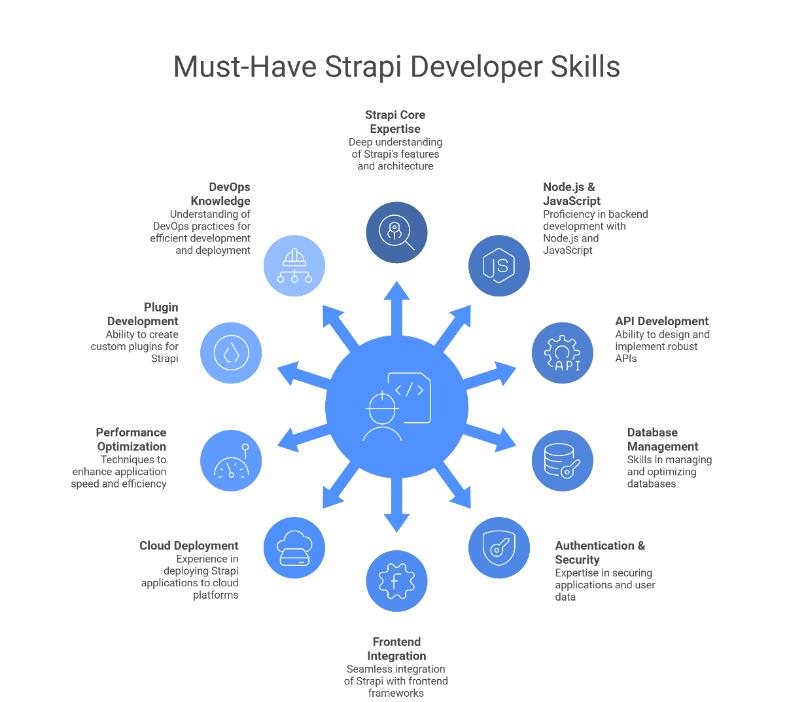
When evaluating candidates or agencies offering Strapi development services, look beyond basic CMS knowledge.
A strong Strapi developer should have the following capabilities.
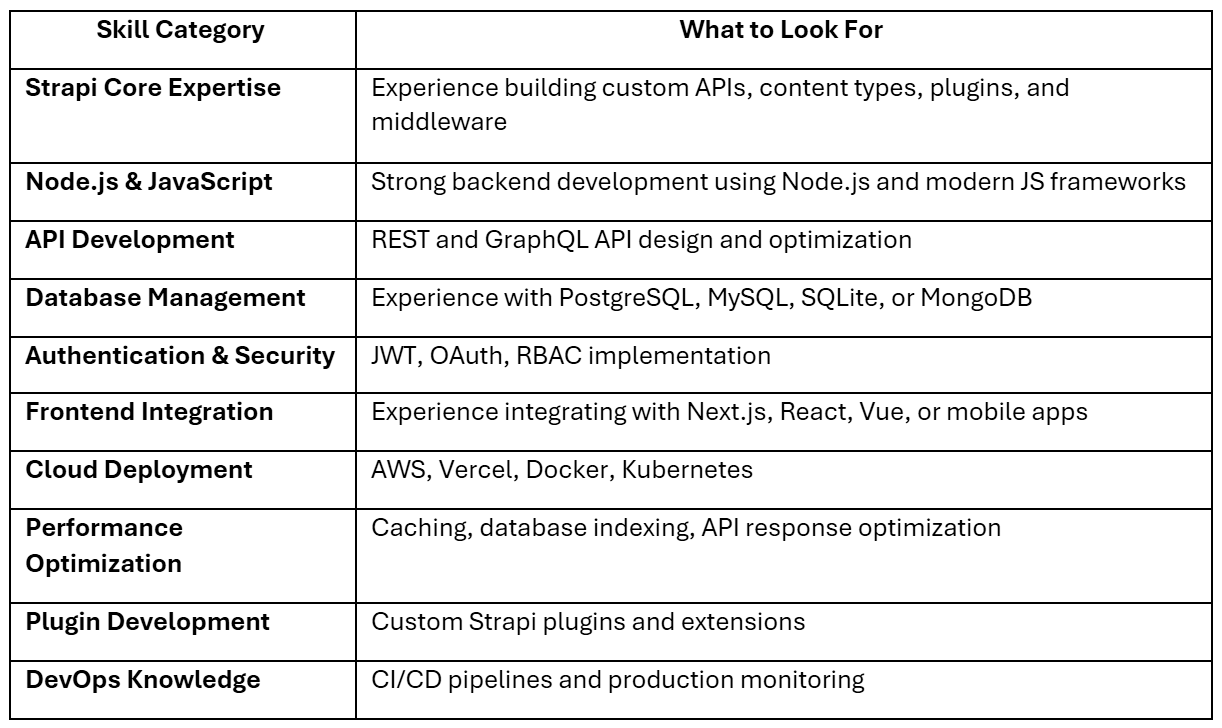
For enterprise projects, it is also important that developers understand:
- scalable API architecture
- microservices environments
- enterprise security compliance
This combination is rarely found in junior developers.
Freelancer vs Strapi Agency vs In-House: Cost and Risk Comparison
Hiring a freelancer might seem cheaper initially. However, for many B2B companies, risk and scalability become major concerns.
Below is a realistic comparison companies often consider:
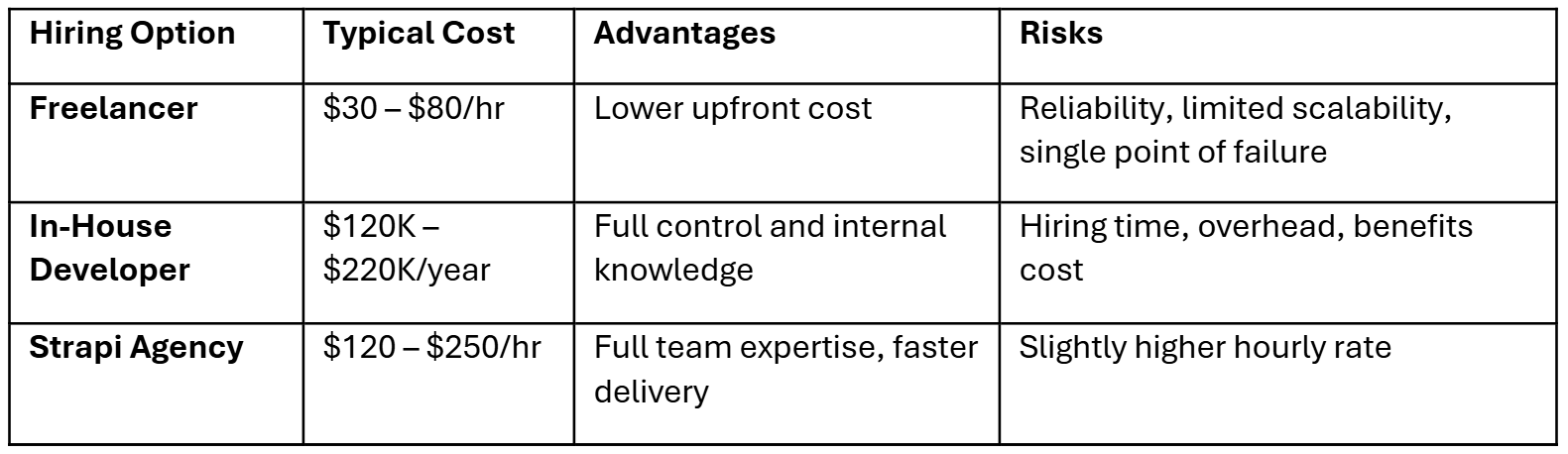
For most companies launching headless CMS platforms, working with a specialized Strapi agency provides the best balance of cost, expertise, and delivery reliability.
8 Questions to Ask Any Strapi Developer Before Hiring
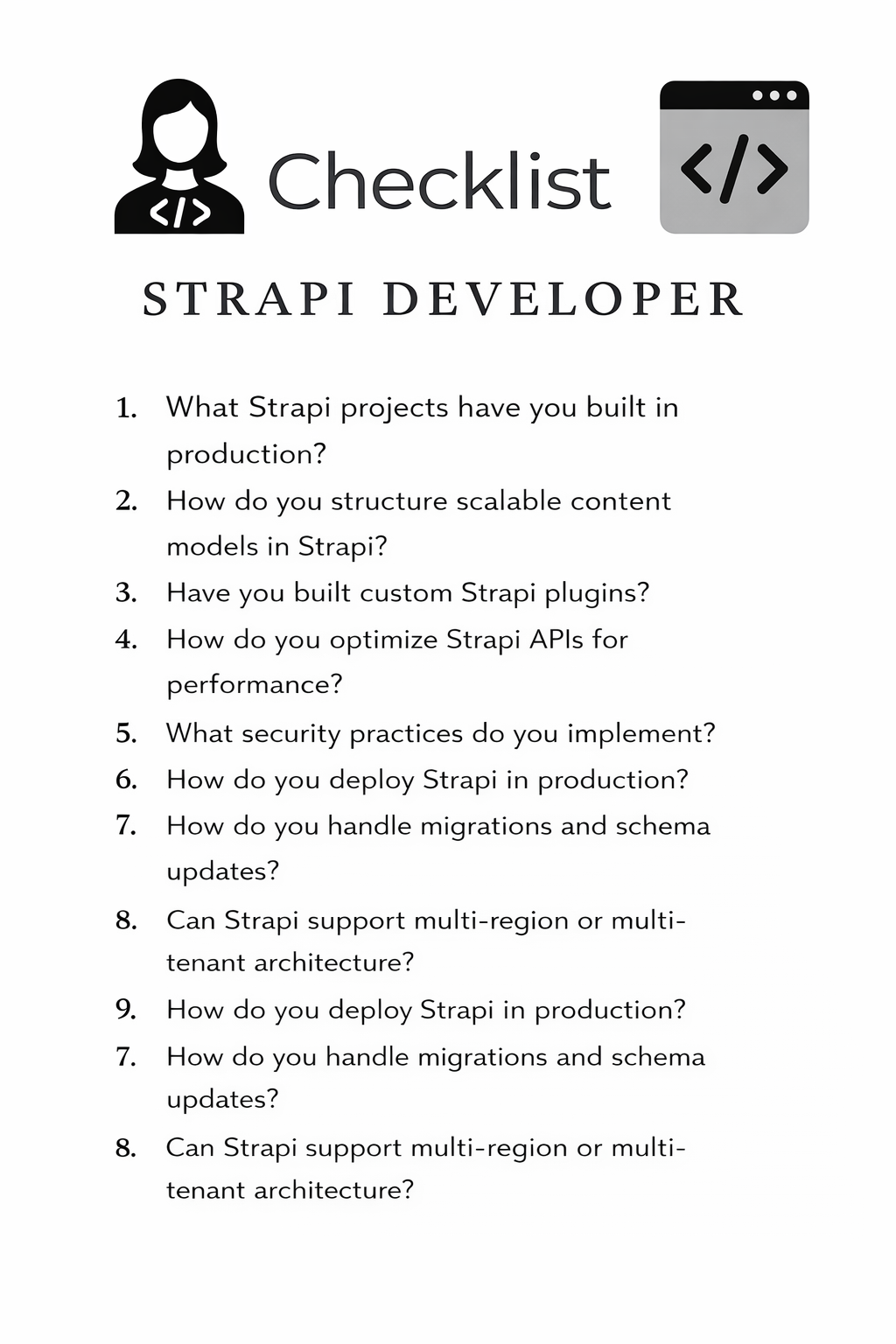
Hiring the right developer often depends on asking the right technical questions. Below are 8 questions you must use to evaluate Strapi expertise of a Strapi agency:
1. What Strapi projects have you built in production?
- Look for real-world deployments rather than prototypes.
2. How do you structure scalable content models in Strapi?
Experienced developers will discuss:
- relational structures
- content reuse
- API efficiency
3. Have you built custom Strapi plugins?
Plugin development shows deeper platform expertise.
4.How do you optimize Strapi APIs for performance?
Expect answers around:
- caching
- database indexing
- API pagination
5. What security practices do you implement?
A strong candidate should mention:
- RBAC configuration
- JWT authentication
- rate limiting
6. How do you deploy Strapi in production?
Common answers include:
- Docker
- AWS
- Kubernetes
- CI/CD pipelines
7. How do you handle migrations and schema updates?
This shows maturity in maintaining live production systems.
8. Can Strapi support multi-region or multi-tenant architecture?
Enterprise projects often require these capabilities.
How the Strapi Team at OpenSpace Services (OSS) Works
Many US companies partner with OpenSpace Services (OSS) because our team offers structured development rather than individual contractors.
Here is how our model at OpenSpace Services (OSS) typically works.
1. Timezone Collaboration
One of the most common concerns US companies have when hiring offshore development teams is communication delays. At OpenSpace Services (OSS) our teams are structured to provide working-hour overlap with US time zones, enabling real-time collaboration with product managers, engineering leaders, and marketing teams.
2. Agile Development Process
Strapi projects often involve API integrations, content architecture design, and frontend framework integrations, which require a disciplined development workflow. OpenSpace Services (OSS) follows a structured agile delivery model to ensure projects remain predictable and scalable.
A typical project workflow includes:
- Discovery and Architecture Planning
- print-Based Development
- QA and Performance Testing
- Staging and Production Deployment
This process ensures consistent delivery for complex projects.
3. NDA and Security
For enterprise clients, data protection and intellectual property ownership are critical requirements when working with external development partners.
OpenSpace Services (OSS) incorporates strict security practices to protect client systems and proprietary architecture.
These measures include:
- signed NDAs
- secure code repositories
- controlled access policies
These safeguards ensure that all code, architecture designs, and digital assets remain fully protected and owned by the client.
4. SLA and Support
Building a CMS platform is only the first step. Long-term success requires continuous monitoring, maintenance, and improvements to keep systems secure and high-performing.
OpenSpace Services (OSS) provides structured service-level agreements (SLAs) that define support expectations and response times, including:
- defined SLAs
- uptime monitoring
- maintenance support
- rapid bug resolution
This makes us ideal for enterprise Strapi development services.
What Our Clients Achieved with Our Strapi Development Services?
Here are some of the top clients for whom we built Strapi-focused digital platforms and delivered measurable business outcomes.
1. ANAROCK
For ANAROCK, we implemented a Strapi-based architecture that streamlined content management across digital platforms while improving scalability for high-traffic environments. The solution enabled better backend flexibility, faster API delivery, and more efficient content operations for their teams.
2. Signet
For Signet, we developed a Strapi-powered backend that simplified complex content workflows and enabled seamless integration with modern frontend frameworks. This helped create a more efficient digital ecosystem and improved content delivery across multiple channels.
3. Micron Miller
For Micron Miller, we implemented a scalable Strapi CMS architecture designed to manage product content more efficiently. The platform improved backend performance and enabled easier updates for digital assets and structured content.
Each of these implementations focused on building robust, scalable Strapi environments tailored to the client’s business requirements.
You can read the detailed case studies here:
ANAROCK – https://www.openspaceservices.com/casestudy/anarock
Signet – https://www.openspaceservices.com/casestudy/signet
Micron Miller – https://www.openspaceservices.com/casestudy/micron-miller
Pricing Guide: What Strapi Development Costs in 2026
The cost of hiring Strapi developers varies depending on project complexity.
Below are common pricing structures.
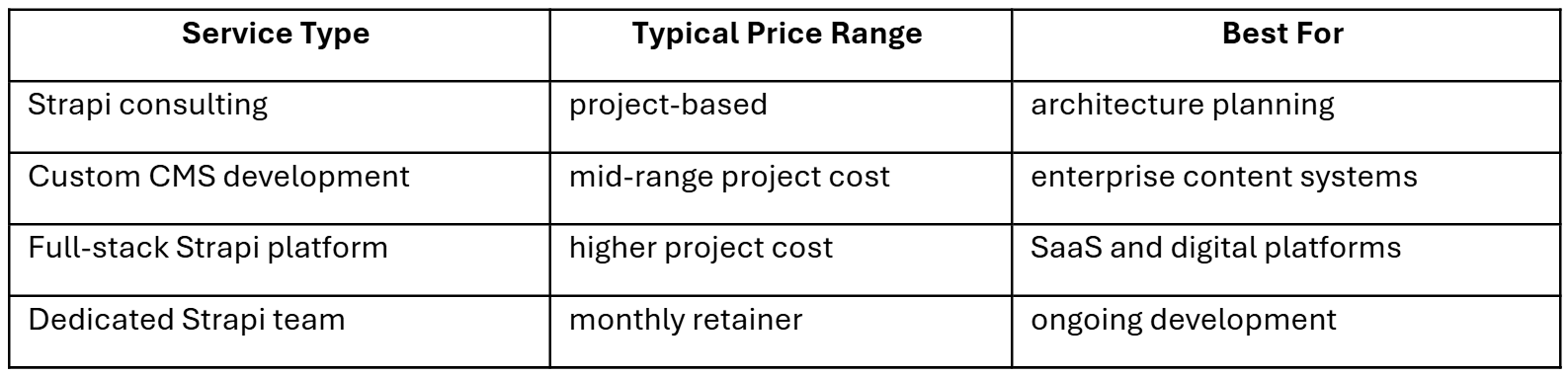
Factors influencing cost include:
- number of content models
- integrations with external systems
- frontend framework complexity
- infrastructure architecture
- performance requirements
Projects involving multi-channel platforms or enterprise integrations typically require specialized Strapi teams.
Why US Companies Choose OpenSpace Services (OSS) for Strapi Development
Many US companies prefer working with offshore development teams but only when those teams combine technical expertise with reliable delivery processes. At OpenSpace Services (OSS), our Strapi specialists focus not just on building CMS platforms, but on delivering measurable business outcomes for every project.
We bring a mix of deep technical expertise and a strong focus on business results, ensuring that the technology supports real operational and growth goals.
Our approach includes:
- Strategic planning to design scalable Strapi architectures that support long-term growth
- Transparent communication so US teams always have visibility into progress and priorities
- Agile project execution with iterative sprints and continuous feedback loops
- Post-launch support to maintain performance, security, and feature updates
- Competitive pricing that allows companies to scale development without excessive overhead
Beyond the development process, we focus on customized solutions rather than templated systems. Every Strapi implementation is designed around the client’s specific infrastructure, integrations, and content workflows.
This combination of technical capability, structured delivery, and business-focused development is why many US companies choose OpenSpace Services (OSS) Strapi development services when they need reliable headless CMS expertise.
Final Thoughts
Strapi has become one of the most powerful open-source CMS platforms for modern digital infrastructure.
However, the success of a Strapi project depends heavily on the expertise of the developers building it.
For companies, the best approach is to:
- evaluate developer expertise carefully
- understand cost vs risk trade-offs
- partner with experienced Strapi specialists
Companies that invest in the right development team build platforms that scale faster, perform better, and require less long-term maintenance.
Experience how OpenSpace Services (OSS) engineers architect and build scalable Strapi solutions. Start with a free 3-day Strapi trial sprint with OpenSpace Services (OSS) and evaluate the team before committing to a full engagement.