


As enterprises accelerate digital transformation, traditional content management systems are struggling to keep up. Rigid architectures, limited scalability, and vendor lock-in have pushed organizations to rethink how they manage and deliver content.
This shift has led many enterprises to adopt Strapi, a modern headless CMS that offers flexibility, scalability, and full control over content infrastructure.
In this article, we explore why enterprises are choosing Strapi as their headless CMS in 2025 and how it supports modern digital platforms.
What Is Strapi and Why is it Gaining Enterprise Adoption?
Strapi is an open-source, API-first headless CMS that allows organizations to manage content independently of the frontend. Unlike traditional CMS platforms, Strapi delivers content via APIs, enabling seamless integration across web, mobile, and SaaS applications.
For enterprises, this means:
- Faster content delivery
- Frontend freedom
- Improved scalability
- Reduced long-term platform risk
Key Reasons Enterprises Choose Strapi
1. API-First Architecture for Omnichannel Delivery
Enterprises today operate across multiple digital touchpoints — websites, mobile apps, internal portals, and SaaS products.
Strapi’s API-first approach enables content to be delivered consistently across all platforms without duplication or rework.
2. Full Ownership Without Vendor Lock-In
Unlike proprietary CMS platforms, Strapi is open-source. Enterprises retain:
- Full ownership of their codebase
- Control over hosting and infrastructure
- Freedom to customize without restrictions
This significantly reduces long-term costs and dependency risks.
3. Enterprise-Grade Security and Access Control
Strapi supports:
- Role-based access control (RBAC)
- Secure authentication and authorization
- Controlled editorial workflows
When implemented correctly through professional Strapi CMS development services, Strapi meets enterprise-level security, compliance, and governance requirements.
4. Frontend Flexibility for Modern Tech Stacks
Enterprises are increasingly adopting modern frontend frameworks such as:
- React
- Next.js
- Vue
- Angular
Strapi integrates seamlessly with these frameworks, allowing development teams to innovate without CMS constraints.
5. Scalability for High-Traffic Applications
Strapi CMS can be deployed in cloud-native environments and scaled horizontally to handle:
- High traffic volumes
- Global content delivery
- Complex data models
This makes it suitable for enterprise portals, SaaS platforms, and content-heavy applications.
Strapi vs Traditional CMS Platforms
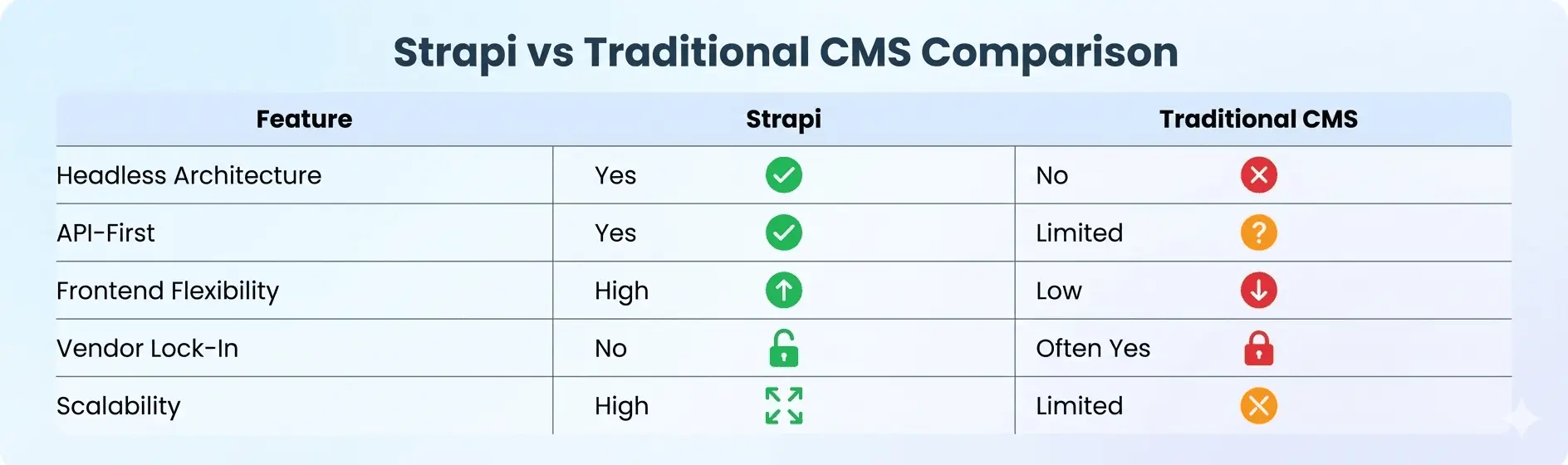
Strapi’s architecture aligns better with modern enterprise requirements than traditional CMS platforms.
Common Enterprise Use Cases for Strapi
Enterprises use Strapi CMS across multiple digital use cases, including:
- Enterprise content platforms
- SaaS product backends
- Multi-region and multilingual websites
- Mobile app content management
- Digital experience platforms
Why Enterprises Choose Official Partners for Strapi CMS Development Services
While Strapi is powerful, enterprise implementations require:
- Proper architecture design
- Security hardening
- Performance optimization
- Long-term maintenance planning
This is why many enterprises choose to work with Official Strapi Partners who follow best practices and ensure production-grade implementations.
Final Thoughts
Strapi has emerged as a leading headless CMS for enterprises by combining flexibility, scalability, and control. As digital ecosystems become more complex, enterprises need CMS platforms that evolve with their business — and Strapi delivers exactly that.
If your organization is considering a modern Strapi headless CMS strategy, Strapi is worth serious evaluation.
Need expert guidance on Strapi implementation or migration?
Talk to an Official Strapi Partner and explore how Strapi can support your enterprise growth.