


Strapi has quickly become a preferred choice for businesses building flexible, API-driven digital platforms. Whether you're launching a new SaaS product, scaling a content-heavy website, or modernising your backend, Strapi offers the flexibility of a headless CMS with full customisation.
But here’s the catch. Choosing to outsource Strapi services without asking the right questions can lead to delays, security risks, and long-term technical debt.
This guide walks you through the key questions to ask before hiring a Strapi development company, so your Strapi API development services investment delivers real business value.
Quick Summary
If you plan to outsource Strapi services, assess your partner’s expertise in API architecture, security, scalability, DevOps, and documentation. The right team prevents performance issues, security gaps, and costly rework.
What Does It Mean to Outsource Strapi Services?
Outsourcing Strapi services means hiring an external Strapi CMS development agency to architect, build, secure, deploy, and maintain your headless CMS backend and APIs instead of building everything in-house.
Outsourcing this typically includes:
- Strapi headless CMS development
- Custom Strapi CMS development
- API architecture design (REST or GraphQL)
- Performance optimisation
- DevOps and deployment
- Ongoing maintenance and scaling
If done correctly, outsourcing reduces time to market and improves architectural quality. If done poorly, it leads to fragile APIs, performance bottlenecks, and security risks.
Now let’s look at what really matters when selecting a partner.
1. Do They Understand Your Business Goals?
Before discussing APIs and databases, your partner should ask about:
- Your product roadmap
- Expected traffic
- Content workflows
- Future integrations
If the conversation starts and ends with “We’ll create collections and endpoints,” that’s surface-level thinking.
A strong Strapi development company focuses on how your backend supports growth.
2. What Is Their Approach to API Architecture?
Strapi allows both REST and GraphQL APIs. But structure matters.
Ask:
- How will you handle API versioning?
- How will you prevent breaking changes?
- What performance optimisations will you use?
According to the Postman 2025 State of the API Report, 82% of organisations now adopt an API-first approach. Among mature API-first companies, 43% generate more than 25% of their revenue through APIs. When you hire Strapi developers, ensure they think long-term, not just launch-ready.
3. How Do They Handle Security?
APIs are common attack surfaces. The OWASP API Security Top 10 highlights broken authentication and misconfigured authorisation as leading risks.
Your Strapi CMS development agency should clearly explain:
- Role-Based Access Control configuration
- JWT token handling
- Rate limiting
- Secure environment management
If security feels like an afterthought, that’s a warning sign.
4. Can They Scale as You Grow?
Strapi works well for startups and enterprise use cases alike. But scaling requires planning.
Ask:
- Which database do you recommend and why?
- Do you implement caching?
- How do you handle increased traffic?
Industry estimates show that the global API market is projected to reach approximately USD 12.54 billion in 2026, signalling strong adoption and growing reliance on API services and infrastructure in modern digital applications.
5. Do They Offer Proper DevOps and Deployment Support?
Reliable Strapi API development services go beyond coding.
Ask:
Will there be separate staging and production environments?
- Do you use CI/CD pipelines?
- How are backups managed?
- Deployment clarity reduces downtime and protects your data.
6. Can You Show Portfolio or Case Studies in Strapi Projects?
Experience matters. Ask for real case studies or examples of Strapi headless cms development they’ve done:
- Actual project architecture
- API endpoints, versioning, and documentation standards
- How they handled security, scalability, and testing
A seasoned strapi development company should articulate how past implementations solved similar business needs.
7. Do They Provide Clear Documentation?
Documentation protects your future flexibility.
Minimum requirements:
- API documentation
- Environment setup guide
- Database schema overview
- Deployment process
Well-documented custom Strapi CMS development ensures you are not locked into one vendor forever.
8. What Testing and QA Processes Do They Follow?
Professional Strapi CMS development services should include:
- Unit testing
- API testing
- Permission validation
- Load testing
Without testing, scaling becomes risky.
9. What Are the Most Common Outsourcing Mistakes?
Based on industry discussions across developer forums and project reviews, common pitfalls include:
- Overcomplicated content structures
- Poor API version control
- No staging environment
- Plugin compatibility issues
- Weak security configuration
These problems are avoidable when you choose experienced Strapi API development services providers.
In-House vs Outsource: What Makes Sense?
Here’s a practical comparison:
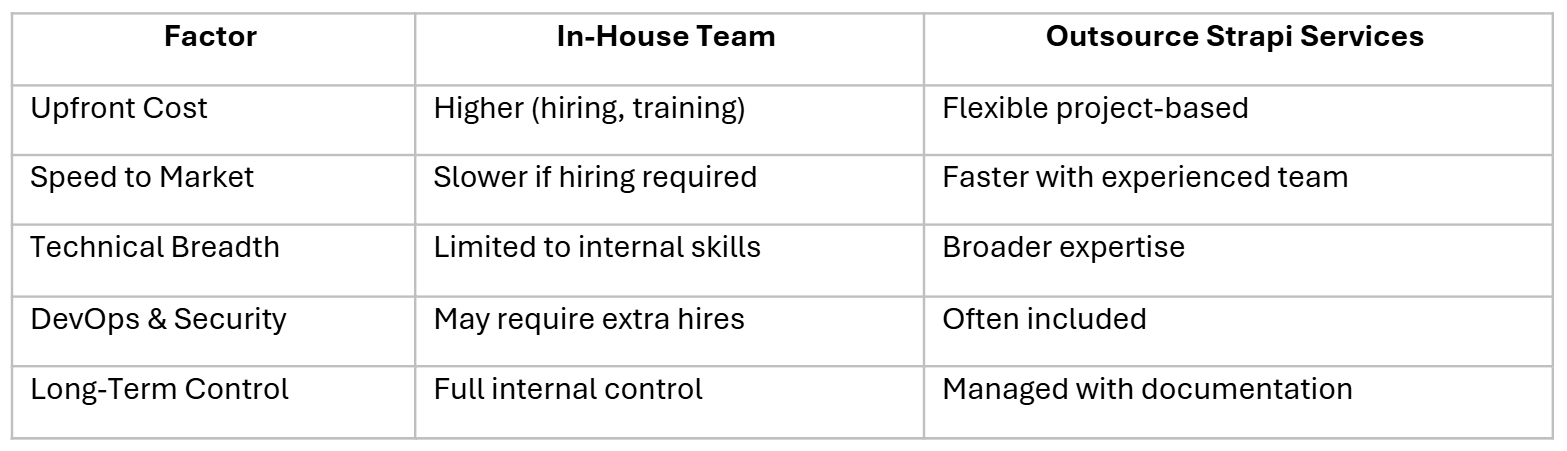
If you already have backend engineers with Strapi experience, in-house can work well.
But if you need faster delivery, architectural guidance, or lack internal expertise, outsourcing to a Strapi development company is often more efficient.
What Openspace Services Offers
At Openspace Services, we provide structured, scalable Strapi CMS development services designed for long-term growth, not just quick launches.
Our approach to Strapi API development services includes:
- Architecture-first planning aligned with your business goals
- Secure, role-based access configuration and API hardening
- Clean, scalable Strapi headless CMS development
- DevOps-ready deployment with staging and production environments
- Clear documentation to ensure long-term maintainability
- Ongoing support and optimisation as your platform evolves
Whether you need custom Strapi CMS development for a SaaS product, enterprise platform, or content-heavy application, we focus on clarity, performance, and reliability from day one.
Final Thoughts
Choosing to outsource Strapi services is not just about reducing workload. It is about partnering with experts who understand API reliability, security, scalability, and long-term maintainability.
Ask the right questions. Review documentation standards. Compare in-house versus outsourced options realistically.
If you are evaluating a Strapi development company for your next backend project, Openspace Services provides structured Strapi CMS development services focused on clarity, performance, and long-term growth.
Let’s build your Strapi backend with confidence.