



A few years ago, choosing a CMS website development was largely about features. Today, it’s about architecture, scale, and execution.
Modern web applications are rarely just websites. They power:
- Web apps and SPAs
- Mobile applications
- Partner portals
- Internal dashboards
This shift has exposed the limitations of monolithic systems, where content, presentation, and logic are tightly coupled. In response, headless architectures have become the default choice for teams building scalable, API-driven products.
Within this landscape, Strapi has emerged as a serious contender. It promises flexibility, developer control, and freedom from vendor lock-in. But those same strengths introduce operational responsibility.
In this blog, we will talk about our experience as a strapi development service. This includes advantages, challenges and some use cases.
What Is Strapi

Strapi is an open-source, Node.js-based headless CMS that allows teams to create structured content and deliver it via REST or GraphQL APIs to any frontend.
Key characteristics include:
- API-first, decoupled architecture
- Self-hosted (you control infrastructure and data)
- Fully custom content models
- Extensible via plugins and custom logic
For teams already evaluating Strapi CMS, the appeal is clear. The real question is how it performs in real-world implementations.
Why Strapi Is a Developer-Led Business Choice
1. Headless Flexibility that Scales with Products
Strapi’s biggest strength is its ability to provide architectural freedom. Content lives independently of presentation, enabling:
- Multiple frontends from a single backend
- Independent deployment cycles
- Easier re-platforming or redesigns
For businesses running multi-touchpoint products, this separation is no longer optional.
2. Faster Backend Setup Through Auto-Generated APIs
Strapi automatically creates API endpoints for every content type. This:
- Reduces backend development time
- Accelerates MVP and proof-of-concept builds
- Allows frontend teams to move faster without waiting on custom APIs
In practice, this often saves strapi developers days if not weeks of initial development, especially for content-heavy platforms.
3. Data Ownership and Compliance Control
Unlike SaaS headless CMS platforms, Strapi is self-hosted. This matters for businesses that:
- Operate in regulated industries
- Handles sensitive customer data
- Require strict compliance (GDPR, HIPAA, internal governance)
Owning your CMS infrastructure means owning your risk, but also your compliance posture.
4. Internationalisation Built for Global Teams
Strapi includes native internationalisation (i18n), enabling:
- Multi-language content from a single system
- Region-specific content logic
- Centralised editorial control
For global businesses, this reduces fragmentation and operational overhead.
5. Extendibility Without Platform Lock-In
Authentication, permissions, media handling, and workflows can be customised deeply. Unlike closed platforms, Strapi allows teams to:
- Write custom middleware
- Extend APIs
- Integrate internal systems directly
This is where Strapi shines for product-led organisations.
Where Strapi Performs Best: Practical Use Cases
1. Omnichannel Content Platforms
Businesses running coordinated campaigns across web, mobile, and partner platforms benefit from Strapi’s single-source-of-truth model.
2. Mobile-First Applications
Strapi works well as a backend for:
- Fitness platforms
- Wellness apps
- EdTech products
Content updates happen centrally and propagate instantly via APIs.
3. Enterprise Content Portals
Large organisations often use Strapi to manage:
- Documentation hubs
- Partner dashboards
- Region-specific B2B portals
The ability to model complex data structures becomes a major advantage.
4. Headless E-commerce Backends
Strapi can act as a content and product information layer, integrating with payment and commerce systems like PayPal.
This separation allows teams to evolve commerce logic independently of content.
5. SaaS Dashboards and Internal Tools
Strapi is increasingly used for:
- Admin panels
- Knowledge bases
- Configuration-driven SaaS platforms
Strapi in Context: How It Compares
Strapi vs Monolithic CMS
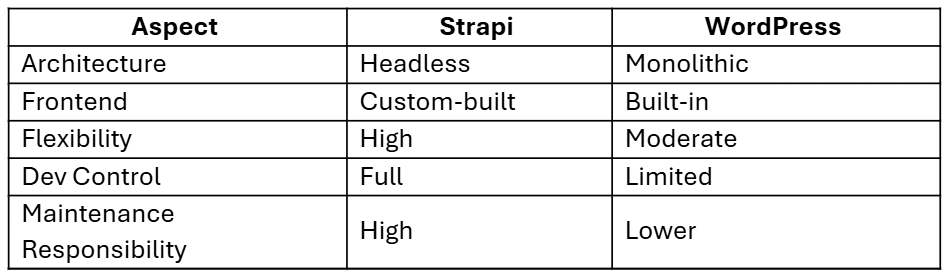
WordPress still excels for simple marketing sites. Strapi wins when custom architecture and scale are priorities.
Strapi vs SaaS Headless CMS
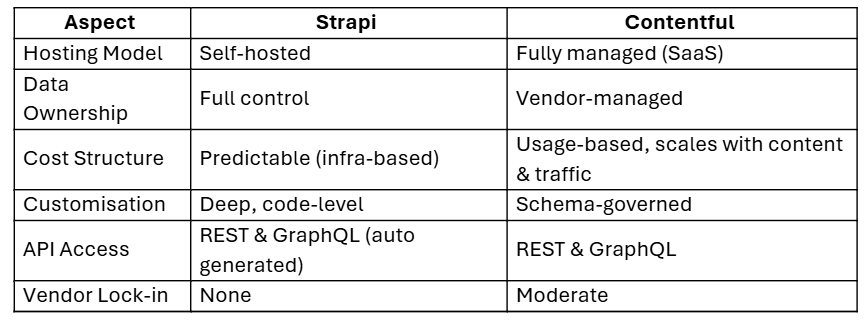
The Real Pitfalls: What Teams Often Underestimate
1. Technical and Operational Ownership
Strapi assumes:
- Node.js expertise
- DevOps maturity
- Clear deployment processes
Without this, projects stall or incur hidden costs.
2. Admin UI and Content Workflow Friction
While functional, Strapi’s admin interface can feel heavy for:
- High-volume editorial teams
- Bulk updates
- Non-technical users
This often requires custom workflow solutions or training.
3. Maintenance and Upgrade Complexity
Major version upgrades may involve:
- Manual dependency updates
- Migration scripts
- Breaking API changes
Teams planning long-term Strapi usage must factor ongoing maintenance, not just launch cost.
4. Hosting Costs Add Up
Although Strapi modular structure is open source, production deployments require robust hosting on platforms like Google Cloud or Amazon Web Services.
Costs increase with:
- Traffic
- Media storage
- Redundancy and backups
This surprises teams comparing Strapi only to “free CMS” narratives.
5. The Serverless Misconception
Strapi is stateful. It is not a plug-and-play serverless application. Production-ready setups require:
- Containers or virtual machines
- Persistent storage
- Background job handling
Understanding this early avoids architectural rework later.
Decision Framework: Is Strapi Right for Your Business?
Strapi Is a Strong Fit If:
- You need deep customisation
- You manage multiple digital touchpoints
- You value data ownership
- You have internal or partner technical expertise
You Should Reconsider If:
- Your needs are limited to a basic content site
- You want zero infrastructure responsibility
- You lack backend development resources
- Speed of launch matters more than flexibility
Conclusion
Strapi is not a “better WordPress.” It is a different class of decision.
For organisations building scalable, API-driven products, Strapi can be a strong foundation. But its success depends less on the tool itself and more on how it is implemented, maintained, and evolved.
For teams evaluating Strapi today, the most important choice is not the CMS. It is choosing the right architecture and the right implementation partner to support it over time.
Planning a Strapi-based product or scaling an existing one? OSS helps teams design, build, and optimise Strapi architectures that are production-ready, secure, and future-proof. Along with Strapi, we also provide services like mobile app development, WordPress development, custom software development, DevOps Services, AI and ML, end to end quality assurance and more. Visit Openspace Services to learn more about their services.