


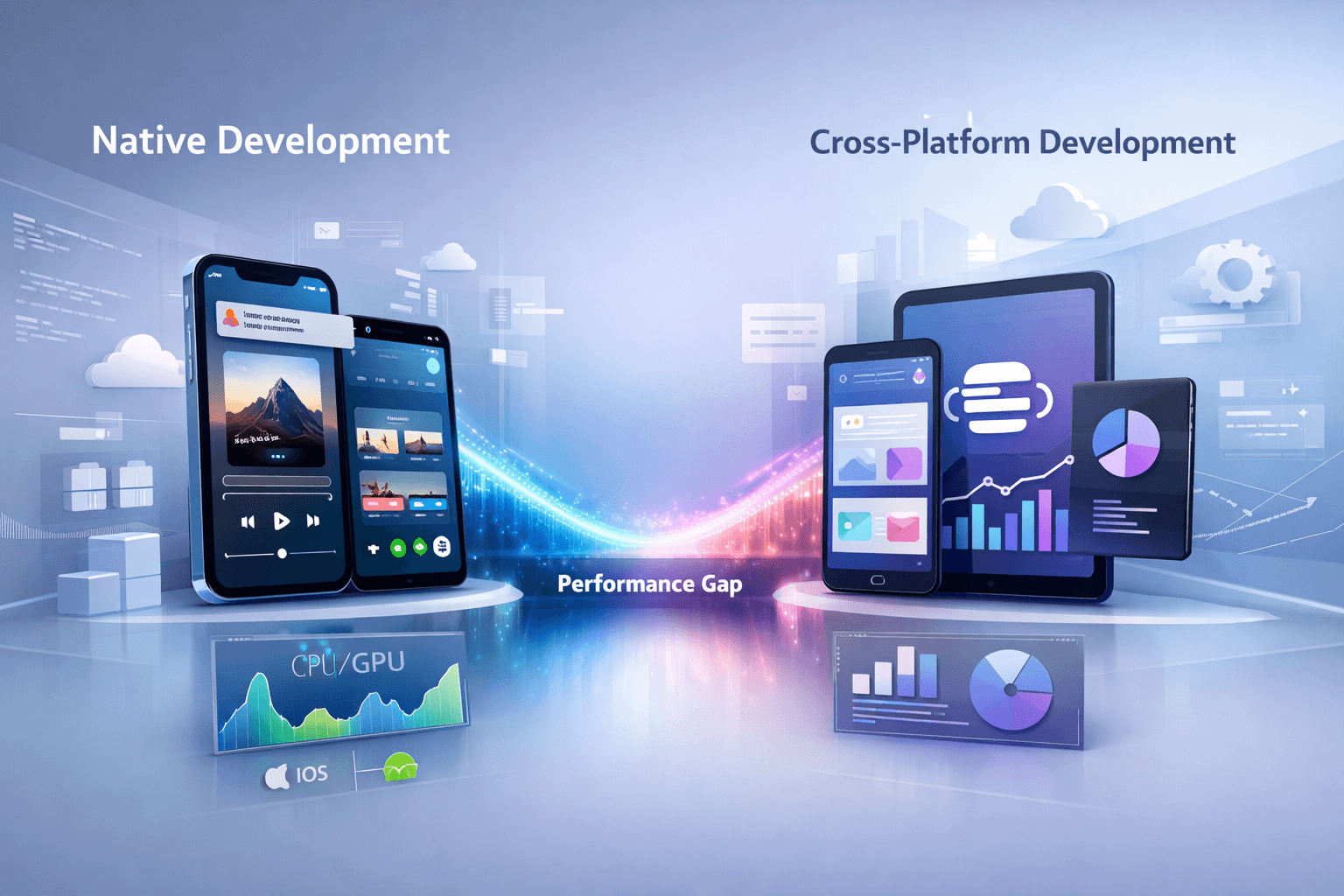
In 2026, the debate around native vs cross-platform mobile development is no longer about which is better. It’s about when the performance gap actually matters.
For most applications, cross-platform frameworks like Flutter and React Native deliver performance that is nearly indistinguishable from native. In fact, industry estimates suggest that around 85% of applications are well-suited for cross-platform development, with only a small segment requiring native-level optimisation.
Businesses evaluating architecture decisions often rely on mobile app development services to balance performance, scalability, and cost effectively
This leaves remaining 15%?
That’s where the wrong decision can cost you performance, scalability, and even revenue.
What Most Teams Still Get Wrong
Most teams don’t fail because they chose the wrong technology. They fail because they optimise for benchmarks instead of real user impact.
- A 0.6-second startup delay rarely affects user retention
- A 10% performance gap is invisible in most apps
- But a 20% latency issue in trading or gaming can break the product
The question is not:
“Is native faster than cross-platform?”
The real question is:
“Will users actually feel the difference in your product?”
Many teams avoid these mistakes by working with experts in custom mobile app development who focus on real user impact rather than theoretical benchmarks
What “Performance” Actually Means in 2026
Before comparing technologies, we need to define performance correctly.
Performance is not a single metric. It is a combination of:
- Frame rate (FPS): UI smoothness
- Startup time: Perceived speed
- Memory usage: Impact on low-end devices
- GPU rendering: Animations, AR, gaming
- API response time: Real-time interactions
- Hardware access: Samera, sensors, Bluetooth
Most performance debates fail because they focus on synthetic benchmarks, not user-perceived experience.
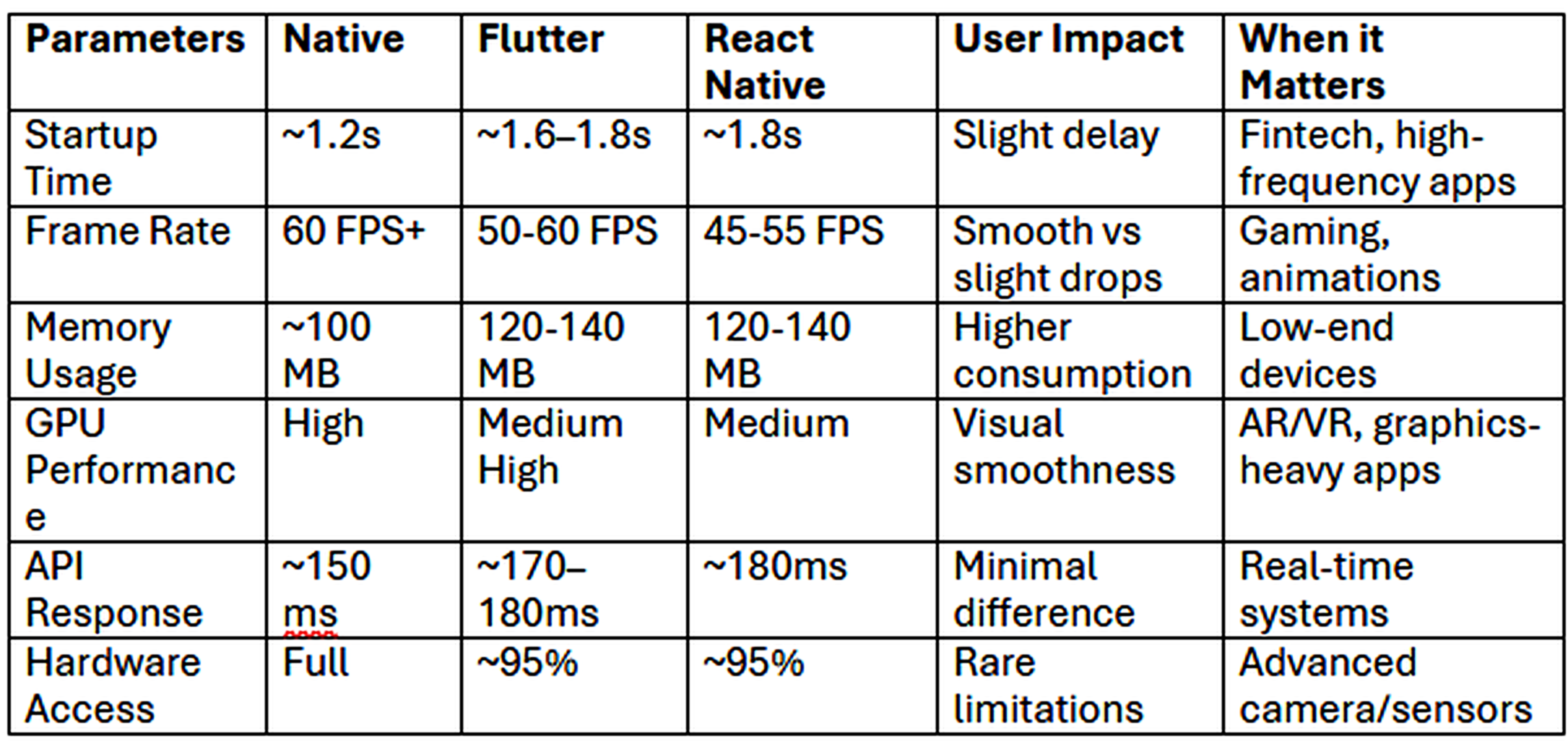
Native vs Flutter vs React Native: Performance Comparison
What This Actually Means
- The startup difference (~0.6s) is rarely noticeable for most apps
- The 5–10% performance gap is invisible in standard use cases
- The gap becomes 20–40% in computation-heavy or GPU-intensive scenarios
Flutter’s official documentation highlights that its direct rendering engine enables near-native performance for most UI-driven applications.
This aligns with improvements in modern frameworks.
For example, meta’s new architecture (Fabric and TurboModules) significantly reduces the JavaScript bridge bottleneck, improving rendering and startup performance.
Where the Performance Gap Actually Shows Up

Users feel performance differences only during these 4 specific conditions:
1. High animation density
- Micro-interactions
- Gesture-heavy interfaces
- Custom UI transitions
2. Real-time data systems
- Trading apps
- Live dashboards
- Multiplayer environments
3. Low-end devices
- Limited RAM
- Older processors
- Battery constraints
4. Heavy GPU workloads
- AR/VR
- Video processing
- 3D rendering
Where users DON’T notice the difference
- Ecommerce apps
- Content platforms
- SaaS dashboards
- Booking apps
- Internal tools
In most consumer applications, users cannot distinguish between native and well-optimised cross-platform apps.
Cases Where Native is Non-Negotiable
1. AR/VR Applications

Apple emphasises that smooth animations and consistent frame rates are critical for delivering high-quality user experiences, especially in graphics-intensive applications. (source)
AR and VR applications rely heavily on real-time rendering, sensor fusion, and GPU acceleration.
- Native apps have direct access to hardware-level APIs like ARKit (iOS) and ARCore (Android)
- Cross-platform layers introduce latency between rendering cycles
What happens with cross-platform:
- Frame drops below 60 FPS
- Motion lag
- Poor depth tracking
Why this matters:
Even small delays can cause:
- Motion sickness
- Disorientation
- Broken immersion
Verdict: If your product relies on immersive experiences, native is not optional.
2. Real-Time Trading and Financial Systems

In trading apps, performance heavily relies on execution speed and accuracy, rather than UX.
- Native apps reduce latency by eliminating abstraction layers
- Cross-platform frameworks introduce additional processing overhead
What breaks in cross-platform:
- Slower order execution
- Delayed price updates
- Inconsistent real-time syncing
Even a 100–200ms delay can result in:
- Missed trades
- Financial loss
- Poor trust in the platform
Verdict: If milliseconds matter, you go native.
3. High-End Gaming

Gaming is one of the most demanding use cases for mobile performance.
- Native engines maintain stable 60 FPS or higher
- Cross-platform apps typically operate in the 45–55 FPS range under load
What users experience:
- Frame drops
- Input lag
- Stuttering gameplay
In competitive or fast-paced games this directly impacts user retention.
Verdict: For serious gaming, cross-platform is a compromise.
4. Advanced Camera and Video Processing Apps

Apps involving:
- Real-time filters
- Video editing
- AI-based image processing
... require deep integration with device hardware.
Native development allows:
- Direct access to camera pipelines
- Efficient frame processing
- Better control over resolution, exposure, and latency
What happens with cross-platform:
- Limited access to advanced camera features
- Performance bottlenecks during processing
- Lower-quality output in edge cases
Verdict: If camera is your core feature, native ensures consistency and quality.
5. Hardware-Intensive Enterprise Applications

Enterprise tools that rely on:
- Bluetooth
- NFC
- IoT integrations
- Custom hardware devices
... need predictable and stable hardware communication.
Cross-platform frameworks cover ~95% of standard use cases, but:
- Edge-case integrations become complex
- Debugging hardware issues becomes harder
What breaks:
- Device connectivity inconsistencies
- Latency in communication
- Limited control over hardware behaviour
Verdict: If your app interacts deeply with hardware, native gives you control and reliability.
Brief Summary:
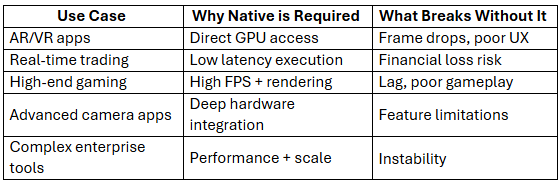
For performance-critical applications, partnering with specialists in high-performance mobile app development ensures architecture decisions align with real-world usage demands.
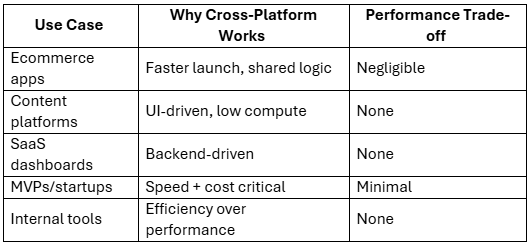
Where Cross-Platform Mobile Application Wins
In most real-world scenarios, performance is not the bottleneck.
The majority of apps are:
- UI-driven
- Backend-dependent
- Interaction-light
And in these cases, cross-platform is strategically better.
1. Ecommerce Applications
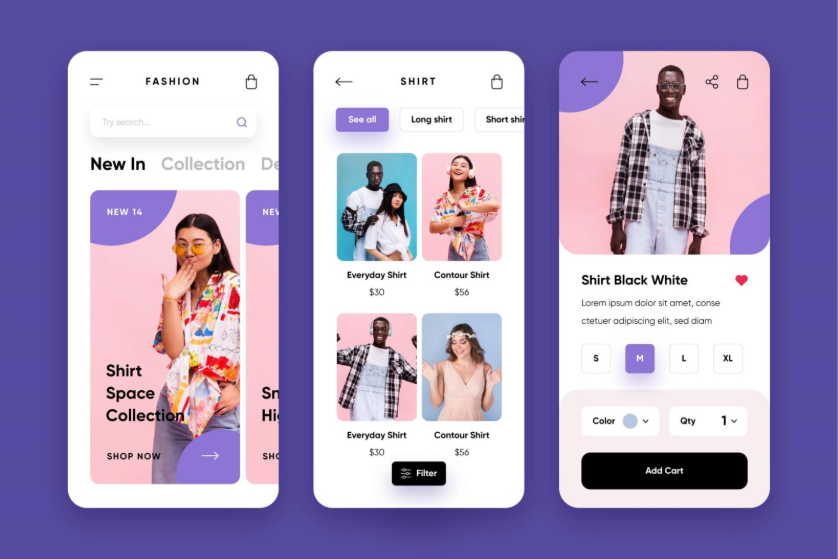
Ecommerce apps are primarily:
- API-driven
- Content-heavy
- Interaction-light
Users care about:
- Product discovery
- Checkout experience
- Speed of navigation
Not:
- GPU performance
- Frame-perfect animations
Reality: A 5–10% performance gap is completely invisible in:
- Product browsing
- Cart interactions
- Payment flows
What matters more:
- Faster feature rollout
- Personalisation
- Marketing integrations
Verdict: Cross-platform is the optimal choice for ecommerce.
2. Content Platforms (Media, Blogs, OTT)

Content apps depend on:
- Backend delivery
- Streaming optimisation
- UI responsiveness
Performance bottlenecks are usually:
- Network speed
- Server response
Not frontend rendering.
Example: Even large-scale platforms have successfully used cross-platform approaches to manage multiple platforms efficiently.
Verdict: Performance differences are negligible; development efficiency matters more.
3. SaaS Dashboards and Business Applications
These apps are:
- Data-driven
- Form-heavy
- Interaction-based
They rely more on backend processing and API response time, rather than UI rendering performance
Verdict: Cross-platform delivers everything needed with faster iteration cycles.
4. MVPs and Startups

For early-stage products, the priority is:
- Speed
- Validation
- Iteration
Cross-platform enables:
- 50–60% faster time-to-market
- Single codebase across platforms
- Smaller teams
What matters:
- Launch fast
- Test assumptions
- Iterate quickly
Verdict: Cross-platform is the smartest starting point for most startups.
5. Internal Tools and Operational Apps

Internal apps are built for:
- Efficiency
- Process optimisation
- Employee usage
They are not:
- Performance-sensitive
- Design-intensive
What matters:
- Stability
- Ease of updates
- Cost efficiency
Verdict: Native development is overkill here.
Brief Summary:
The Cost vs Performance Trade-Off
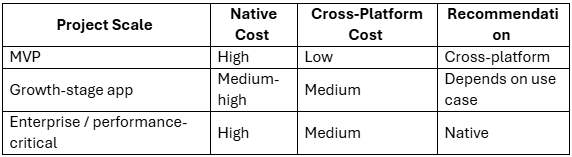
Code Reuse:
Cross-platform enables 60–90% code reuse. In fact, Disney+ Hotstar achieved ~85% code sharing across platforms using React Native.
The Real Decision Driver:
Performance only justifies higher cost when it directly impacts revenue, retention, or core product experience.
In such scenarios, businesses often choose cross-platform mobile app development services to accelerate delivery while maintaining consistent performance.
The Openspace Services Mobile Decision Framework
At Openspace Services, we don’t approach mobile development as a binary choice between native and cross-platform.
We evaluate every project using a structured decision model designed to balance performance, cost, and scalability.
This framework is used internally across projects to determine the most efficient architecture.
How We Evaluate Mobile Architecture
Every project is assessed across five key factors:
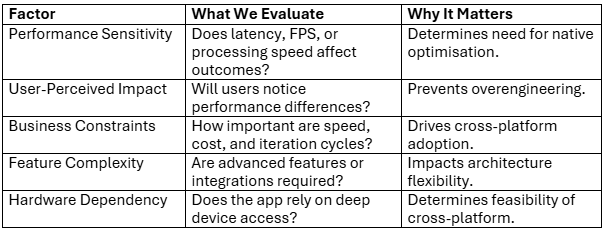
How We Score Each Project
Each factor is classified as:
- Low
- Medium
- High
We optimise not for perfection but to optimise for what matters most to the product.
How We Make the Decision
Instead of forcing a binary choice, we look at the pattern across all five factors.
- If most factors are Low to Medium: Cross-platform is the default choice
- If multiple factors are High: Native becomes necessary
- If the scores are mixed: We recommend a hybrid architecture
What This Looks Like in Practice
A typical ecommerce app:
- Low performance sensitivity
- High business urgency
We recommend cross-platform for speed and efficiency
A real-time trading platform:
- High performance sensitivity
- High latency dependency
We recommend native for execution reliability
A fintech app with complex integrations:
- Mixed performance and feature requirements
We recommend a hybrid approach (cross-platform + native modules)
Why We Use This Framework
Most teams make architecture decisions based on:
- Trends
- Assumptions
- Or incomplete benchmarks
This framework forces a different approach.
It ensures that:
- Performance is prioritised only where it matters
- Business constraints are factored into technical decisions
- Teams avoid both overengineering and underbuilding
Also Read: How to Choose the Right Mobile App Development Agency for your Business
Final Verdict: What Should You Choose?
If you are:
- Startup founder: Cross-platform
- Ecommerce brand: Cross-platform
- SaaS product: Cross-platform
- Fintech / trading platform: Native
- Gaming / AR company: Native
If you’re unsure start with cross-platform. Optimise or migrate later only if performance becomes a bottleneck.
Key Takeaways
- Most apps do not need native performance
- The performance gap is situational, not universal
- Cross-platform is faster, cheaper, and scalable for most use cases
- Native is critical only when performance directly impacts outcomes
- The smartest decision is based on product requirements, not assumptions
Ready to Build the Right Mobile App?
Choosing between native and cross-platform is not about trends—it’s about making the right technical decision for your product.
If you’re building a mobile app and want clarity on:
- Architecture
- Performance trade-offs
- Cost vs scalability
Talk to our team at Openspace Services. We’ll help you choose—and build—the right solution for your business. We have worked with brands across various sectors including e-commerce, fintech, government websites, real estate, shipping and more. Contact us today.