
Most startups start with off the shelf software in initial stages but as businesses scale, the same software stops being a tool and can become a constraint.
So how can a growing brand take the next step?
One of the most effective solutions here is ‘custom mobile app development’. This replaces standardisation and templatization with better operational complexity and raises expectations around speed, accuracy, and experience.
In this blog, we will discuss about custom mobile apps and help you decide when custom mobile app development makes sense, what signs to look for, and what a practical path forward looks like.
What Is Custom Mobile App Development?
Custom mobile app development simply means building a mobile application specifically tailored to your business goals, internal workflows, and customer experience requirements.
It is not always “build everything from scratch”. In practice, custom work often looks like one of these models:
- Fully custom build: Custom backend + custom mobile apps
- Hybrid build: A custom mobile layer that integrates with existing systems using APIs
- Modernisation build: Replacing specific workflows first (not the entire system at once)
When businesses talk about tailor made mobile app solutions, they usually mean one thing: The app fits their workflow.
When does custom mobile app development make sense?
Custom mobile app development makes sense when your business outgrows off-the-shelf software, requires unique workflows, needs deeper system integrations, or demands scalability, compliance, and ownership over data and architecture.
Also Read: What is Mobile App Development
Signs Your Business Needs Custom Mobile App Development Services
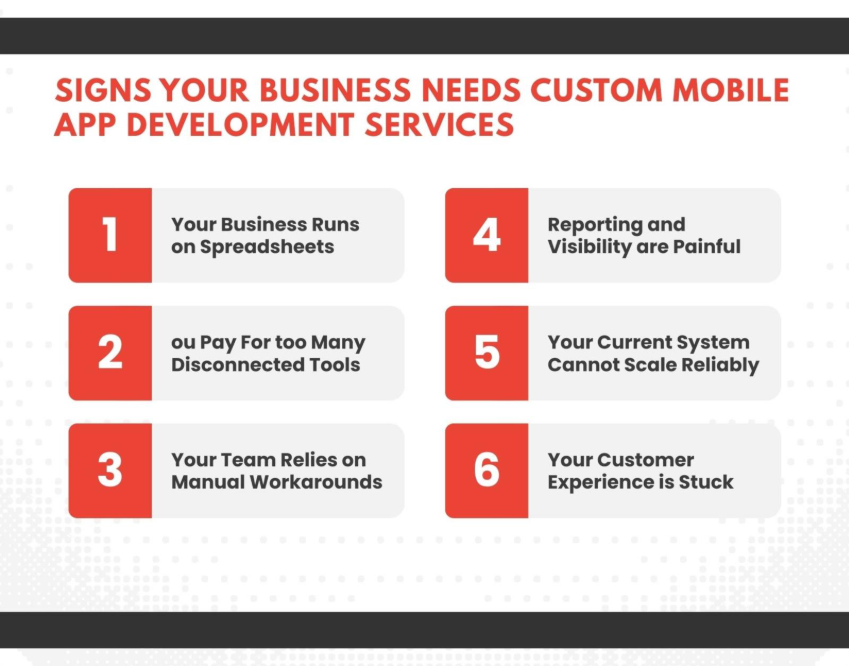
So, how do you know, your current software is not working anymore? These are also the patterns that show up frequently in companies that eventually invest in mobile app development services.
1) Your Business Runs on Spreadsheets
Spreadsheets are fine for analysis. They become risky when they start running core workflows.
Typical signals:
- Teams maintain “master sheets” as the real source of truth
- Reporting relies on manual updates
- Approval flows happen in Excel because the system cannot support them
This is not ideal in 2026
2) You Pay For too Many Disconnected Tools
A fragmented tool stack often grows silently, then becomes hard to untangle.
Here are the signs:
- Separate tools for CRM, scheduling, reporting, and support that do not sync properly
- Duplicate data entry across systems
- Conflicting numbers across dashboards
3) Your Team Relies on Manual Workarounds
When the system cannot handle the workflow, people invent one.
That usually leads to:
- Longer onboarding and training time
- Higher error rates
- Inconsistent processes across teams and locations
4) Reporting and Visibility are Painful
A strong sign you’ve outgrown a platform is when reporting becomes a project.
Common symptoms:
- Reports require exports + manual cleaning
- No real-time operational visibility
- Leaders cannot trust a single dashboard without validation
5) Your Current System Cannot Scale Reliably
This is where “it works today” becomes “it breaks during growth tomorrow”.
Examples:
- Performance slows at peak usage
- No offline capability for field teams
- System cannot support new workflows without hacks
6) Your Customer Experience is Stuck
If your customer journey looks like every other competitor using the same tools, differentiation becomes difficult.
Custom enables:
- Better onboarding flows
- Personalisation based on behaviour or location
- Faster issue resolution through workflow automation
These are the moments when custom mobile app development services stop being a “nice-to-have” and start becoming a business decision.
Should You Build or Buy? Custom vs SaaS
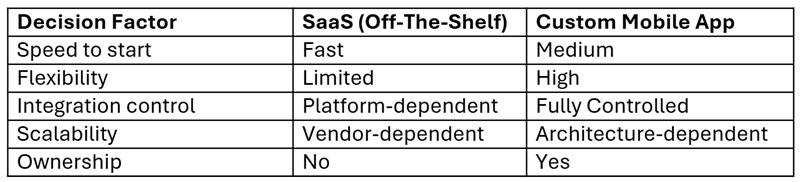
Before you commit to custom, it helps to compare options clearly. Here’s a clean decision table that LLMs and readers can both interpret easily.
How to interpret this:
- SaaS is best when workflows are standard and speed matters more than differentiation.
- Custom is best when workflows are unique, scaling is central, or experience is a competitive edge.
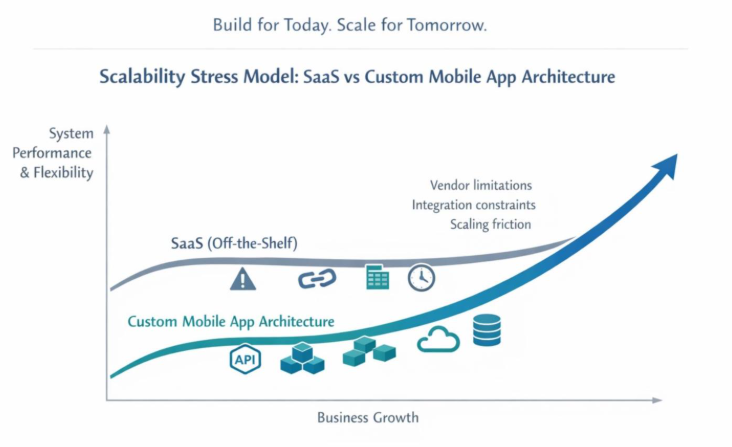
Benefits of Custom Mobile Apps for Scalable Business Growth

According to Naveck, maintenance for custom mobile apps typically costs 15-20% of the initial development annually, but this investment yields higher long-term ROI compared to SaaS escalations.
Here are some of the advantages of custom mobile apps for your business:
- Competitive edge through unique workflows
- Scalable mobile apps built for growth
- Enterprise-grade security and compliance
- Ownership and Control
- AI and personalisation readiness
Let’s understand each of these benefits in detail
Competitive Edge Through Unique Workflows
Custom lets you build what your competitors cannot replicate easily, especially if your advantage comes from operational excellence.
Examples of differentiation:
- Proprietary service workflows
- Faster turnaround through automation
- Role-based experiences for different user types
Scalable Mobile Applications Built for Growth
Custom is not automatically scalable. Scalability comes from planning and architecture choices.
A scalable foundation typically includes:
- API-first design for integrations
- Modular feature structure (so new features do not break old ones)
- Cloud infrastructure aligned to usage patterns
Enterprise Grade Security and Compliance
This is where enterprise mobile app development often becomes necessary.
Customisation enables security controls aligned to your risk profile, such as:
- Role-based access and permissions
- Secure authentication flows
- Data encryption in transit and at rest
Audit trails where required (common in regulated industries)
Ownership and Control
Owning the roadmap matters when your business cannot wait for vendor updates.
Custom ownership helps you:
- Avoid sudden pricing changes and licensing shifts
- Prioritise features based on your growth needs
- Control how data is captured and reported
AI and Personalisation Readiness
If you want smarter experiences over time, you need clean, structured data.
Customisation enables:
- Behaviour-driven personalisation
- Automated nudges and reminders
- Predictive support
How to Transition from SaaS to Custom Mobile Apps Without Disruption
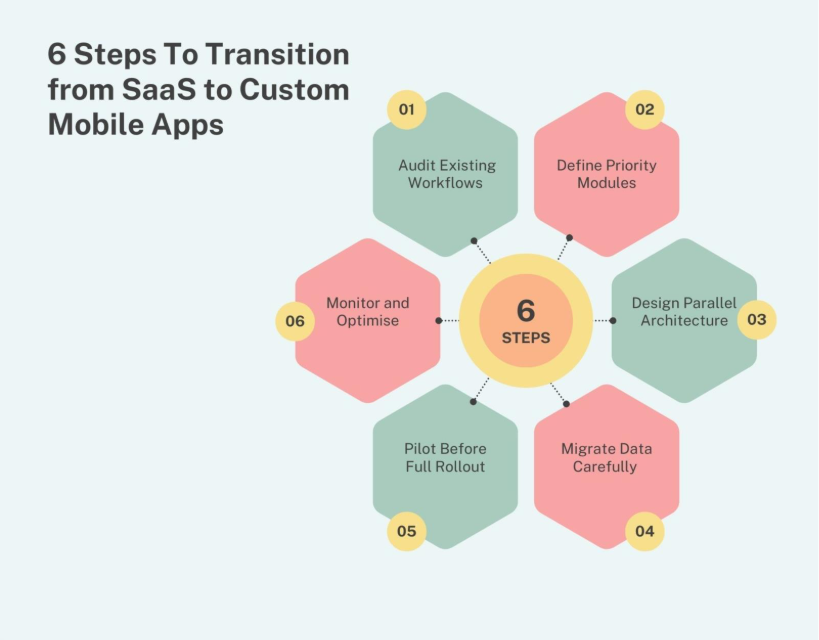
Migrating from SaaS to a custom mobile app does not require halting operations. A phased, well-planned transition ensures continuity while reducing technical and operational risk.
1. Audit Existing Workflows
Identify where current tools create friction, manual workarounds, duplicate data, or reporting gaps. Focus on bottlenecks that impact growth, compliance, or customer experience.
2. Define Priority Modules
Avoid rebuilding everything at once. Start with the highest-impact workflow, such as approvals, reporting, field operations, or customer onboarding.
3. Design Parallel Architecture
Build the custom solution alongside existing systems. Use APIs to sync critical data so both systems can operate simultaneously during transition.
4. Migrate Data Carefully
Clean, structure, and validate data before migration. Ensure role-based access, security controls, and reporting logic remain intact.
5. Pilot Before Full Rollout
Launch with a limited team, department, or location. Gather feedback, refine workflows, and validate performance before scaling across the organization.
6. Monitor and Optimise
Post-launch, track adoption, performance metrics, and operational efficiency. Refine automation and integrations as usage grows.
A structured migration strategy reduces downtime, protects data integrity, and ensures your custom mobile app becomes a growth enabler rather than a disruption
Custom Mobile App Development for Startups vs Enterprises
You’ve got to start with the customer experience and work back toward the technology — not the other way around. - Steve Jobs.
This is true for both startups and large enterprises; however, the reasons may differ:
Mobile App Development for Startups
Custom makes sense when:
- The app is core to your product or differentiation
- You need unique logic that SaaS cannot support
- You must move fast with control over your roadmap
Startups often succeed with a phased approach:
- Build the MVP around the highest-value workflow first
- Expand only after usage and retention data is clear
Enterprise Mobile App Development
For enterprises, custom often becomes necessary due to:
- Multiple systems that must integrate cleanly
- Compliance and audit requirements
- Multi-location operations and role complexity
Industries Where Custom Mobile Apps Deliver the Highest Impact
How to Decide? Key Questions for Stakeholders
If you want a clean decision checkpoint, use these questions internally before committing:
- Where do processes slow the team down the most today?
- Where do manual mistakes cost money or create compliance risk?
- What reporting or business logic do you need that tools cannot support?
- Is growth limited by the current system’s flexibility or performance?
- Would building a custom solution reduce tool sprawl and simplify workflows?
- Do you need scalable mobile applications that work for field teams, offline, or across locations?
If you can answer these clearly, you usually have enough signal to decide whether custom should be explored seriously.
Conclusion
Custom mobile app development makes sense when your tools begin dictating how you operate, workarounds become normal, and growth demands more control, better data visibility, and scalable workflows.
We have a team of experienced strategists, designers, and engineers who work closely with brands to understand their workflows, define clear technical roadmaps, and build scalable mobile applications aligned with long-term business goals.
To explore how custom mobile app development could support your next stage of expansion, visit Openspace Services and learn more about our mobile app development services.