

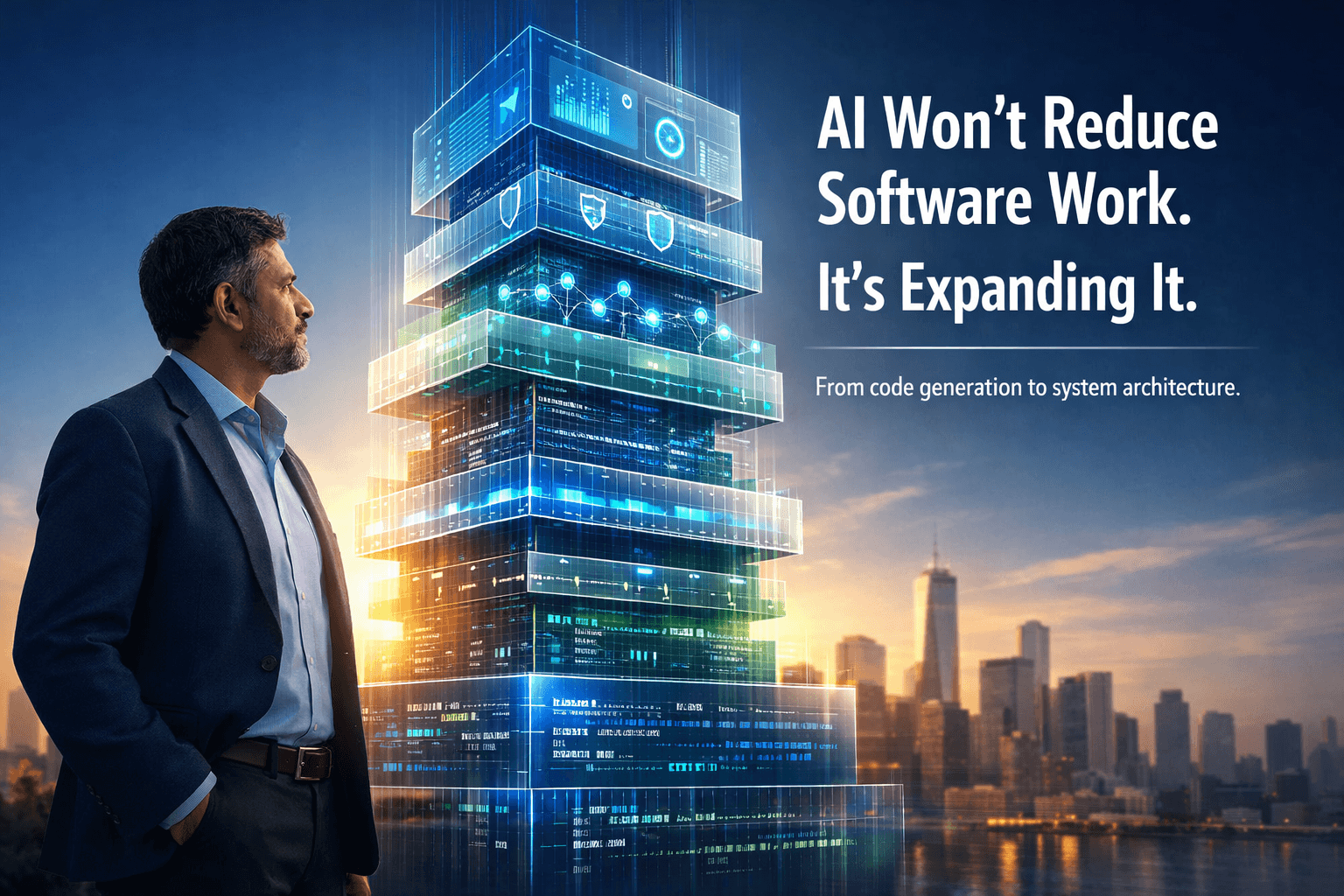
Artificial Intelligence Isn’t Reducing Software Work — It’s Expanding It
While AI is automating repetitive coding tasks, it is also introducing new layers of architectural complexity, governance requirements, integration challenges, and rising product expectations. For the software industry, AI is not simply a productivity shortcut — it is a force multiplier for complexity.
This is where engineering teams increasingly rely on modern software development partners to manage scalability, architecture, and AI-driven complexity.
For software developers, this shift represents both a major opportunity and a structural transformation in how software is built, maintained, and scaled.
TL;DR
- AI is likely to increase the overall workload in the software industry rather than reduce it
- Demand is shifting from basic coding to architecture, integrations, AI oversight, and governance
- Developers need stronger system design, domain expertise, and AI collaboration skills
- The industry is evolving from code writing to system orchestration
- Engineers who adapt will become significantly more valuable within modern development teams
Why AI Will Increase Work in the Software Industry
AI can accelerate code generation, but it also expands system scope, technical complexity, and business expectations. Faster development cycles often lead to more features, more integrations, more experimentation, and significantly more maintenance, monitoring, and governance responsibilities.
Historically, every major productivity breakthrough in software has increased demand instead of reducing it.
When cloud computing emerged, it didn’t eliminate technical jobs — it created new roles in DevOps, cloud architecture, cybersecurity, and FinOps. When mobile platforms scaled, backend ecosystems became more complex and demanding.
AI is following the same pattern — only at a much faster pace.
This shift is closely tied to how modern systems are evolving, especially with trends like platform engineering and DevOps transformation.
Here’s why software workload is expected to grow:
1. Faster Output Raises Business Expectations
When AI tools can generate code in minutes, stakeholders begin expecting product features in days instead of weeks.
This leads to:
- Shorter release cycles
- More iterations and revisions
- Continuous experimentation
- Higher product velocity
As a result, engineering teams are expected to deliver more — not less.
2. AI Systems Require More Infrastructure
AI is not a simple feature toggle. It introduces an entirely new technical layer that requires:
- Model orchestration
- Data pipelines
- Monitoring systems
- Evaluation frameworks
- Security controls
- Compliance mechanisms
Every AI-powered feature adds complexity to the backend and increases the demand for system reliability, observability, and performance. Designing and managing this complexity often requires specialised DevOps and cloud architecture services.
3. Governance Becomes a Core Requirement
Organizations cannot responsibly deploy AI without strong governance frameworks in place.
This includes:
- Bias monitoring
- Explainability mechanisms
- Data governance
- Audit trails
- Regulatory compliance
Developers are no longer just building applications — they are increasingly responsible for building accountable, transparent, and trustworthy AI systems.
What Kind of Work Will Increase?
The growth in workload will not come from boilerplate coding. Instead, it will shift toward higher-value engineering responsibilities.
Traditional Focus vs AI-Era Focus
Writing CRUD logic → Designing AI-assisted workflows
Feature implementation → Model integration and orchestration
Manual debugging → AI output validation and verification
Static architecture → Adaptive, feedback-driven systems
Code delivery → Reliability, observability, and governance
The net effect is clear: complexity moves up the stack.
Will AI Replace Software Developers?
Not entirely — but it will replace certain categories of software work.
Developers who rely only on syntax-level coding are at the highest risk. AI is already highly capable of:
- Generating boilerplate code
- Writing unit tests
- Refactoring repetitive patterns
- Explaining standard documentation
However, AI still struggles with:
- Ambiguous business logic
- Architectural trade-offs
- Performance optimization at scale
- Cross-system integration decisions
- Regulatory and security constraints
The future belongs to developers who operate at the systems and decision-making level.
How Should Software Developers Prepare for This Shift?
Preparing for the AI era is less about learning tools and more about evolving your engineering mindset.
1. Strengthen System Design Skills
As AI increases complexity, developers must become stronger in:
- Distributed systems thinking
- Scalability planning
- Failure mode analysis
- Observability design
- Model versioning and drift management
System-level thinking will become a key differentiator.
2. Learn to Collaborate With AI — Not Compete Against It
AI copilots are quickly becoming standard across development workflows. For teams building AI-enabled applications, understanding how to design scalable software architectures becomes equally critical.
Developers who know how to:
- Write effective prompts
- Critically validate AI-generated output
- Break down problems strategically
- Use AI for rapid prototyping
…will outperform those who ignore it.
The real advantage is not simply using AI — it is knowing when not to trust it.
3. Build Strong Domain Expertise
Generic coding is increasingly automatable. Domain expertise is not.
Deep understanding of areas such as:
- Healthcare compliance
- Financial systems integrity
- Supply chain operations
- Enterprise security standards
…makes developers far more valuable and difficult to replace.
AI can generate code. Domain experts define the rules, constraints, and risks.
4. Develop AI Literacy — Not Just Coding Skills
Modern developers should understand:
- How models are trained
- What hallucinations ar
- Why bias occurs
- How to evaluate model performance
- The trade-offs between open-source and proprietary models
You don’t need to train models yourself — but you do need to understand how and why they fail.
5. Focus on Engineering Judgment
In the AI era, one of the highest-value skills is judgment.
That includes knowing:
- When to automate
- When to build vs buy
- When to use AI vs rule-based systems
- When generated output is acceptable
- When risk outweighs speed
Judgment remains one of the most human and least automatable skills in software engineering.
How Will AI Change the Structure of Software Teams?
AI will likely reshape team structures in several important ways:
- Fewer repetitive junior-level coding tasks
- Greater demand for senior engineers and architects
- Growth of hybrid roles combining backend, AI, data, and MLOps skills
- Stronger overlap between product, engineering, and governance functions
Software teams will become more architecture-driven, cross-functional, and accountability-focused.
The role of the “developer” is evolving into that of a system operator, integrator, and decision-maker
What Risks Should Developers Be Aware Of?
AI adoption introduces several critical risks that developers must actively manage:
- Overreliance on AI-generated code
- Security vulnerabilities in auto-generated logic
- Data leakage through prompts and external tools
- Poorly evaluated AI features reaching production
- Erosion of foundational coding and debugging skills
To remain effective, developers must continue strengthening their technical fundamentals while embracing AI responsibly.
The Bigger Industry Shift
AI is not shrinking the software industry — it is expanding the range of problems software can solve.
Businesses that previously could not justify automation can now:
- Build intelligent support systems
- Automate internal workflows
- Personalize customer experiences
- Launch AI-native products and services
This means more software will be built — potentially by smaller but more capable engineering teams. The industry is not contracting. It is intensifying.
As AI reshapes software development, organization's need the right architecture, systems, and strategy to scale effectively. Explore how OpenSpace Services helps teams build AI-ready systems with scalable engineering, DevOps, and modern architecture solutions.
Final Perspective
Artificial intelligence is not reducing work in the software industry.
It is raising the bar.
Developers who see AI only as a productivity tool may gain short-term benefits. But developers who recognize AI as a structural shift in how software is designed, built, and governed will be the ones who lead the next decade.
The future of software development is not less human.
It is more strategic, more architectural, and more responsibility-driven.
And that ultimately means more work — not less.