The mobile landscape in 2026 is hyper-competitive and technologically nuanced. Businesses from the tech hubs of New York to the booming digital corridors of India face the same critical dilemma when planning their mobile strategy: Should we build a single app that runs on both platforms, or invest in distinct, platform-specific applications?
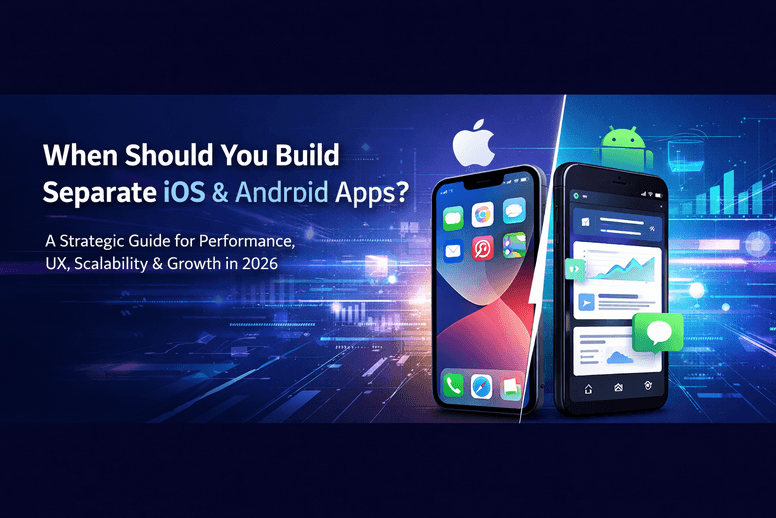
This isn't just a technical decision; it's a fundamental business strategy. The right choice affects development costs, time-to-market, user experience, and, ultimately, your bottom line. At OpenSpace Services, we navigate these complexities daily. This guide explores the rationale behind choosing separate iOS and android app development, a strategy known as native mobile app development, and compares it with cross platform mobile app development to help you determine the best path for your 2026 roadmap.
The Allure of Cross-Platform in 2026
Before diving into the "why" of separate apps, it's essential to understand the modern alternative. Cross-platform frameworks like Kotlin Multiplatform (KMP), Flutter, and React Native have made significant leaps. They promise a tempting proposition: "Write once, run everywhere."
The apparent benefits are obvious:
- Potentially Lower Initial Cost: Sharing a codebase can reduce upfront development expenses.
- Faster MVP Launch: A simultaneous release on both the Apple App Store and Google Play.
- Unified Development Team: Managing one team skilled in one framework instead of two separate teams.
So, if cross-platform is so appealing, why do successful global companies and high-growth startups still heavily invest in native mobile app development? The answer lies in performance, user experience, and access to the latest platform innovations; the critical differentiators in today's market.
The Case for Separate Apps: When Only Native Will Do
Deciding to build separate iOS and Android apps is a commitment to maximizing the potential of each ecosystem. It means partnering with a dedicated iOS app development company and an android app development company to create two distinct, high-performance products.
1. Performance and Responsiveness: The "Zero Lag" Imperative
The tolerance for sluggish apps in 2026 is zero. Today's users demand instant responsiveness, whether they are using the latest iPhone 17 or a high-end Android flagship. Native apps interact directly with the device's hardware and OS APIs, resulting in:
- Snappier Load Times: Vital for user retention in high-stakes industries like Fintech.
- Smoother Animations: Critical for a premium feel, especially with the 120Hz displays now standard on most devices.
- Resource Efficiency: Better battery management and memory usage.
OpenSpace Field Note: In our recent optimization audits, we’ve noted that native iOS applications utilizing the latest concurrency models consistently maintain a fluid 60fps-120fps frame rate during complex data visualization; where comparable cross-platform builds often throttle on mid-range Android devices. This "micro-friction" is often what leads to user churn.
2. Access to Advanced Device Features
The smartphone of 2026 is packed with sophisticated hardware. 5G/6G capabilities, advanced ML/AI accelerators, and spatial computing features are mainstream. When you choose separate iOS and android app development, you get immediate access to:
- Apple’s "Liquid Glass" UI & ARKit: For immersive iOS experiences.
- Android’s Jetpack Compose & Neural Networks API: For high-speed on-device AI.
Cross-platform frameworks often lag. If your app relies on advanced camera capabilities, NFC, or on-device machine learning, native development is the only way to unlock this functionality without compromising stability.
3. Uncompromised User Experience (UX)
iOS and Android users have deeply ingrained behaviors.
- iOS Users expect specific navigation patterns and the "Liquid Glass" design language that emphasizes translucency and depth.
- Android Users are accustomed to Material Design 3, with its specific back-button behaviors and adaptive layouts.
Building natively allows you to embrace these unique design languages. An app that feels "at home" on the device builds instant trust. In contrast, cross-platform apps often feel like a "one-size-fits-none" compromise.
The 2026 Strategic Matrix: USA vs. India
Your decision should also be guided by where your users are. The market dynamics in the US and India are drastically different, and a "separate app" strategy allows you to pivot your resources accordingly.
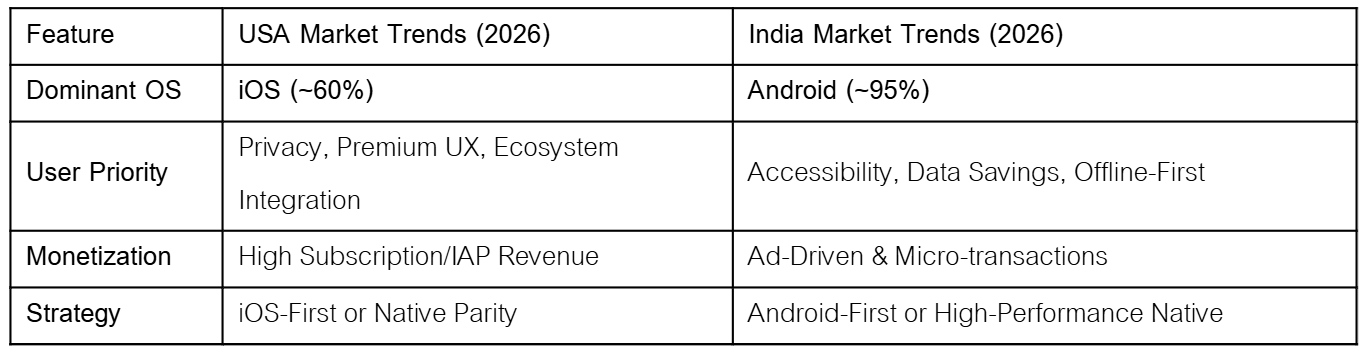
Market Intelligence: Our deployment data shows a distinct "Feature Appetite" gap. US-based iOS users frequently adopt new OS-level features (like Dynamic Island interactions) within weeks. Conversely, our broader Android user base in India prioritizes battery optimization and low-latency performance on varying hardware.
The Cost-Complexity Reality (The 18-Month Rule)
One of the biggest myths is that separate apps are always more expensive. While the initial build cost is higher, the long-term maintenance of complex cross-platform codebases can be far more volatile.
The "Cost-Cross" Point: Based on our internal lifecycle tracking, the "Cost-Cross" point typically occurs around month 18. By this stage, the technical debt of maintaining custom "bridges" for cross-platform frameworks often matches or exceeds the cost of maintaining two clean, native codebases. For enterprise-grade applications with a 3+ year roadmap, separate apps offer a more predictable Total Cost of Ownership (TCO).
When Should You Choose Each Path?
Choose Separate Native Apps If:
- High-Performance is Non-Negotiable: You are building a game, a high-frequency trading app, or a heavy media editor.
- You Need "Day Zero" Support: You want to support new iOS, or Android features the day they are announced.
- User Trust is Paramount: You are in Healthcare or Fintech where native security biometrics (Face ID/Fingerprint) integration must be flawless.
- Long-Term Roadmap: You have been building a core product that will be the face of your company for years.
Choose Cross-Platform If:
- MVP Validation: You need to test a simple concept on both platforms with a limited budget.
- Content-Centric Apps: Your app is primarily for displaying text and images (e.g., a simple blog or internal corporate directory).
- Limited Hardware Interaction: You don't need complex access to the phone's GPU or specialized sensors.
Conclusion: Earning the Citation in 2026
In the era of AI-driven search and high user expectations, "good enough" is no longer a viable mobile strategy. Whether you are targeting the affluent iOS market in the US or the massive Android user base in India, your app must feel purposeful and native.
At OpenSpace Services, we specialize in providing high-end mobile app development services. We help brands decide not just how to build, but why to build in a specific way to ensure long-term scalability.
Are you ready to define your mobile strategy for 2026? Contact us today for a technical audit of your app concept, and let's determine if separate native builds or a high-performance cross-platform approach is right for your goals.